Choosing between frameless and framed glass partitions is a difficult decision that many architects, designers, office managers and business owners face when preparing for a fit-out or renovation.
However, it's not exclusively down to the aesthetic benefits of both modern office partitions. Choosing a framed or frameless glass partition system can shape your office for years to come, influencing your workspace's overall functionality, flexibility, and acoustic quality, among others.
Choosing a framed or frameless system can shape your office for years to come.
Both framed and frameless glass partitioning offer benefits for commercial spaces, but understanding their unique nuances and characteristics is vital, whatever your involvement or role in such a project.
This guide breaks down the key differences between frameless and framed glass partitions to help you make a well-informed decision.
What Do Frameless Glass Partitions Offer?
Frameless glass office partitioning epitomises modern minimalism, creating consistent, clean, uninterrupted lines in offices that improve the perception of space and light. They remove visible structural elements from view, allowing the glass itself to become a quintessential design feature.
The Pure collection, for example, represents frameless glass design, with systems like Pure 20 delivering ultra-slim 20mm profiles that virtually disappear when installed.
They create a sense of sophistication in offices that feel open, airy, and brighter, which, for many commercial offices, is a priority. This supports collaborative, functional and dynamic office environments.
They are also incredibly practical, with minimal maintenance needed due to their fewer structural elements. Custom frameless glass partitions can also add architectural depth to offices, with curved or angled configurations representing premium precision engineering.
Modern frameless glass systems deliver impressive acoustic performance alongside their minimalist aesthetic, with frameless single glazed partitions and double glazed options like Pure 54 and the Pure 100 providing excellent sound insulation. Triple glazed Pure 200 is also available and more suited for windows – rather than full-height screens – ideal for environments such as recording or podcast studios.
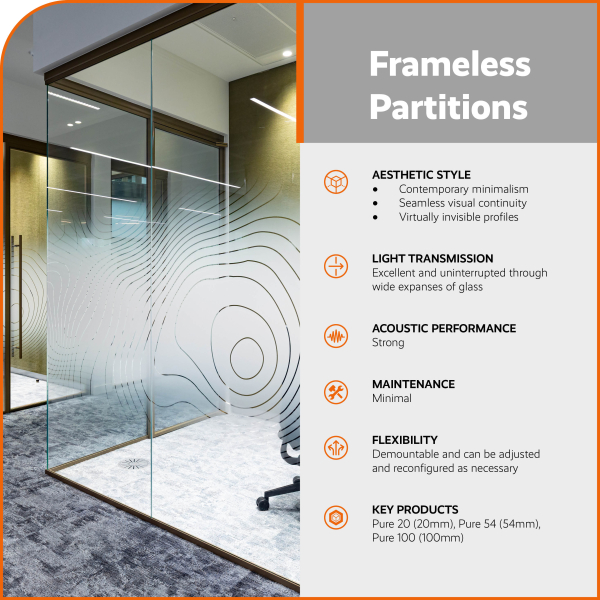
Frameless: Pure collection
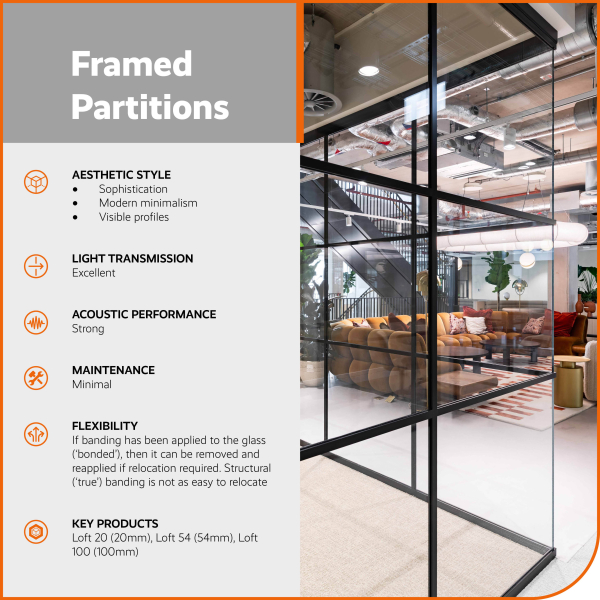
Framed: Loft collection
What Do Framed Glass Partitions Offer?
Framed systems champion structural elements as key features in their design and appearance, and while the framework is visible, it can complement an office design. The Loft collection, for instance, contains a characteristic banded styling that brings industrial charm to contemporary spaces.
Partition bands can be bonded directly to the glass after partition installation, spaced at regular intervals, or arranged in more unconventional patterns to suit the desired aesthetic.
Alternatively, the bands can be formed from fully extruded aluminium, with each section housing its own individual pane of glass. This allows for even greater design flexibility, for example, mixing different glazing types in adjacent panels.
If structural design expression is important, framed systems should be considered. They are particularly valuable for spaces that seek to evoke authentic industrial charm, with the frame elements becoming one and the same with the surrounding environment.
Frames/banding can also be matched on adjoining glazed doors.
Glass Partition Comparison Table
| Consideration | Frameless Systems | Framed Systems |
| Aesthetic Style | Contemporary minimalism, seamless visual continuity, virtually invisible profiles | Sophistication, modern minimalism, visible profiles |
| Light Transmission | Excellent and uninterrupted through wide expanses of glass | Excellent |
| Acoustic Performance | Strong | Strong |
| Investment Level | Often higher due to sophisticated engineering and installation requirements | Can be considered better value for money as installation is less tricky |
| Maintenance | Minimal | Minimal |
| Flexibility | Demountable and can be adjusted and reconfigured as necessary | If banding has been applied to the glass ('bonded'), then it can be removed and reapplied if relocation required. Structural ('true') banding is not as easy to relocate. |
| Key Products | Pure 20 (20mm), Pure 54 (54mm), Pure 100 (100mm) | Loft 20 (20mm), Loft 54 (54mm), Loft 100 (100mm) |
Choosing Framed or Frameless Partitioning
The decision between frameless and framed systems depends on your specific priorities and requirements.
Consider frameless partition solutions when you need:
- Contemporary minimalist aesthetics
- An abundance of light
- Solid acoustic performance
- Flexibility to adjust as your business scales
Consider framed partition solutions when you need:
- Minimalist sophistication
- Contemporary qualities
- Good acoustic performance
- Adaptability
Working with experienced specialists ensures optimal specification for your specific requirements.
Elevate Your Office Aesthetics Today
Both partition styles offer a wealth of compelling benefits, and the optimal choice depends on your specific vision, requirements, and priorities. The best strategy is to work with glass partition specialists who understand both approaches and can guide you to the solution that best serves your objectives.


 About Us

 Our Approach